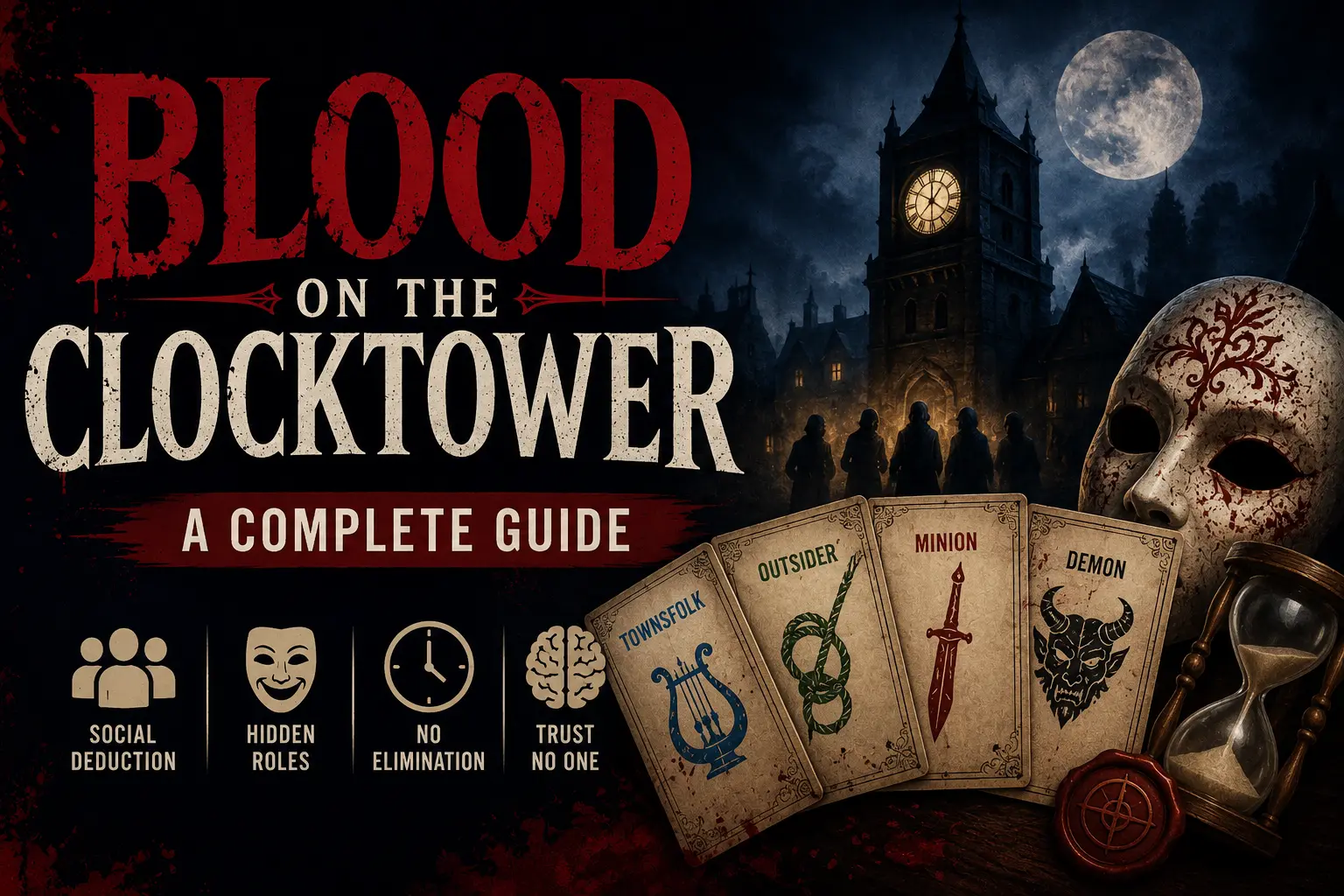
Blood on the Clocktower is a social deduction game built around a Storyteller who runs a living, breathing script. Players hold secret roles, share false and true information, and work together, or against each other, to find a hidden Demon before it kills the town.
This guide covers the roles, setup, and flow of a standard game.
What Is Blood on the Clocktower?
One player takes the Demon role and kills a townsfolk each night. A group of Minions serve the Demon and lie to protect it. Everyone else works to identify and execute the Demon before the town runs out of people.
Unlike many social deduction games, dead players stay in the discussion. A dead player loses their vote in most cases but keeps a single ghost vote for later use, and keeps talking, reasoning, and pointing fingers for the rest of the game.
Good and Evil win conditions:
- Good wins when the town executes the Demon.
- Evil wins when only two players remain alive, or when specific script conditions trigger a loss for Good.
Players and Group Size
Blood on the Clocktower supports 5 to 20 players. Team size scales with player count:
- 5 to 6 players: 1 Demon, 1 Minion
- 7 to 9 players: 1 Demon, 1 Minion
- 10 to 12 players: 1 Demon, 2 Minions
- 13 to 15 players: 1 Demon, 3 Minions
- 16 to 20 players: 1 Demon, 4 Minions
The Storyteller sets remaining seats as Townsfolk, with one Outsider added for smaller counts and more added as the group grows, based on the script’s balance sheet.
One player runs the game as Storyteller. This role does not play a side and instead adjudicates every night action, tracks information, and narrates events.
Roles in the Game
Roles split into four types.
Townsfolk
The largest group. Each Townsfolk holds a unique power that helps Good find the Demon. Examples: the Washerwoman learns that one of two players holds a specific Townsfolk role, the Empath learns how many of their living neighbors are Evil each night, the Fortune Teller picks two players each night and learns whether either is the Demon.
Outsiders
Also Good, though their abilities work against the town in some way. Examples: the Butler must follow another player’s vote, the Recluse may register as Evil to other characters’ abilities, the Saint loses the game for Good if executed.
Minions
Evil players who serve the Demon. Minions know each other and know the Demon’s identity from the start. Examples: the Poisoner disables a player’s ability for a night and day, the Baron adds extra Outsiders to the setup, the Scarlet Woman becomes the new Demon if the original Demon dies with five or more players alive.
Demon
The Evil leader. Kills one player each night. If the Demon dies, Evil usually loses unless a Minion ability keeps their side alive. Examples: the Imp, the Vigormortis, the Fang Gu, each with different night powers beyond the basic kill.
Setup
- Pick a Storyteller and a script (a set curated list of roles, such as Trouble Brewing, the standard starting script).
- The Storyteller counts players and sets the Townsfolk, Outsider, Minion, and Demon split.
- The Storyteller selects specific roles from the script for this game, matching the required counts.
- Each player draws or receives a role token in secret.
- Players look at their own role and keep it hidden for the rest of the game.
- The Storyteller may give private information to certain roles on night one, such as the Demon learning their Minions, or Minions learning the Demon.
Night Phase
The Storyteller calls for eyes closed. Roles wake in the order listed on the script’s night sheet, one at a time.
Typical first night order includes:
- Minions and Demon learn each other’s identities.
- Roles with a “starts knowing” ability, such as the Washerwoman or Librarian, receive their first clue.
- Any player whose ability triggers only on night one takes their action.
Typical later night order includes:
- Roles with ongoing information abilities, such as the Empath or Fortune Teller, take their action and receive an answer.
- Roles that alter other players, such as the Poisoner or Monk, act before the kill.
- The Demon chooses a kill target.
- The Storyteller resolves the kill based on protections and other role interactions in play.
Each role wakes separately, gives a silent signal to the Storyteller, and closes their eyes again before the next role wakes.
Day Phase
The Storyteller announces who died overnight, if anyone, and opens the floor for discussion.
Typical Day phase structure:
- Announcement. Deaths from the night are revealed. No cause is given, only who died.
- Discussion. Players share information, real or false, question each other, and build theories. This phase runs open and unstructured, often for 10 minutes or longer.
- Nomination. Any living player may nominate another player for execution. A player may also nominate themselves.
- Vote. All players who are alive, plus any dead player with an unused ghost vote, may vote on each nomination as it happens.
- Execution. The nominee with the most votes, above a majority threshold set by the Storyteller, gets executed. At most one execution happens per day, though some days see none.
Winning Conditions
- Good wins when the town executes the Demon.
- Evil wins when the number of living players drops to two, since the Demon and one other player cannot be outvoted at that point.
- Certain roles carry special loss conditions for Good, such as executing the Saint, which the Storyteller enforces as written on the script.
Strategy Tips for Good
- Share information early. A Townsfolk ability means nothing if kept secret until it is too late to act on.
- Cross reference claims. If two players both claim the same unique role, one lies.
- Watch who defends whom. Minions protect the Demon with subtle, consistent support across the game.
- Track the Storyteller’s public statements about deaths and executions. Patterns emerge across several days.
Strategy Tips for Evil
- Build a consistent cover story before day one discussion starts.
- Let Good execute a Minion occasionally to protect the Demon’s identity.
- Use the Poisoner or similar disabling roles to corrupt the information Good relies on, without revealing that any corruption happened.
- Coordinate quietly. Minions should back each other’s claims without appearing too aligned.
Common Scripts
Blood on the Clocktower ships with several official scripts, each with a different flavor:
- Trouble Brewing: The introductory script, balanced for new groups learning core mechanics.
- Bad Moon Rising: Adds pressure through death-focused roles and higher lethality.
- Sects and Violets: Adds madness and misregistration effects that complicate information gathering.
Custom scripts exist in large numbers within the community, each built around a specific theme or difficulty level.
Quick Reference
| Phase | Action |
|---|---|
| Night | Roles wake in script order, Demon kills |
| Day | Discuss, nominate, vote, execute |
| Win | Good executes the Demon, or Evil reaches two players remaining |
Gather your group, pick a Storyteller, and start with Trouble Brewing for your first game. The mix of open discussion and hidden information rewards close listening more than any single strategy.