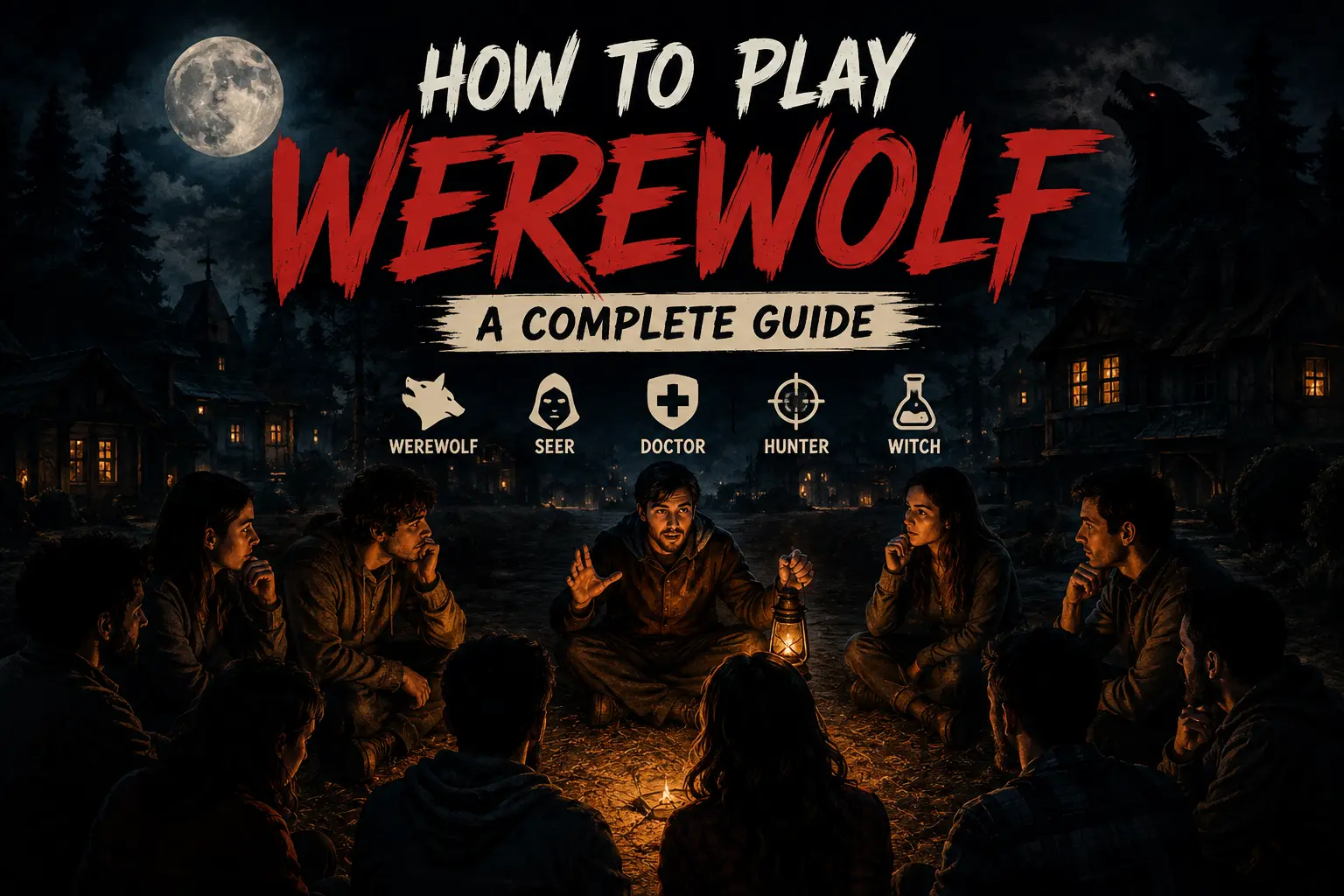
Werewolf is a social deduction game. Players talk, lie, and vote to find hidden killers among them. No board. No cards required. Only a group of people and a moderator.
This guide covers the roles, setup, and flow of a standard game. Use this as your reference for game night.
What Is Werewolf?
A small group of players secretly become Werewolves. The rest become Villagers, plus a few special roles. The game alternates between Night phases, where Werewolves kill in secret, and Day phases, where the group discusses and votes to eliminate a suspect.
Villagers win when they eliminate every Werewolf. Werewolves win when their numbers equal or outnumber the Villagers.
Players and Group Size
Werewolf works best with 7 to 15 players. Below 6, roles run thin and deduction gets shallow. Above 15, split into two games or add a moderator to keep pace.
A rough guide for Werewolf count:
- 6 to 8 players: 2 Werewolves
- 9 to 12 players: 3 Werewolves
- 13 to 15 players: 4 Werewolves
One player sits out as Narrator (also called Moderator). This person runs the Night and Day phases and does not play a side.
Roles in the Game
Villager
No special power. Villagers vote during the Day and rely on discussion and observation to find Werewolves.
Werewolf
Wakes at night and picks a victim with the other Werewolves. During the Day, Werewolves pretend to be Villagers and try to redirect suspicion.
Seer
Wakes each night and asks the Narrator to reveal one player’s true side. The Seer stays quiet about this information or risks becoming a target.
Doctor
Wakes each night and picks one player to protect. If Werewolves target that player, the attack fails. A Doctor often protects themselves, though rules vary by group.
Hunter
An ordinary Villager during play. If the Hunter dies, by vote or attack, they name one other player to eliminate immediately.
Witch (optional)
Holds two potions: one to save a victim from a Werewolf attack, one to kill any player. Each potion is used once per game.
Setup
- Pick a Narrator.
- Choose roles based on group size using the guide above.
- Write each role on a card or slip of paper, one per player.
- Shuffle and deal one card to each player, face down.
- Players look at their own card without showing anyone else.
- Cards stay hidden for the rest of the game.
Night Phase
The Narrator calls: “Night falls. Everyone close your eyes.”
Then, in order:
- Werewolves wake. They open their eyes, silently agree on a target using hand signals, then close their eyes again.
- Seer wakes. Points at one player. The Narrator nods for Werewolf, shakes head for Villager side.
- Doctor wakes. Points at one player to protect.
- Witch wakes (if included). Decides whether to save the Werewolf victim or poison another player.
Each role wakes and sleeps separately so no one learns who holds which role.
The Narrator announces: “Morning comes.” Everyone opens their eyes and learns who died overnight, if anyone.
Day Phase
Surviving players discuss openly. Typical Day phase structure:
- Announcement. The Narrator reveals last night’s victim, if any.
- Discussion. Players share suspicions, defend themselves, and question others. Set a timer, 5 to 10 minutes works well.
- Nomination. Any player names a suspect for elimination.
- Vote. All surviving players vote. Majority wins.
- Elimination. The voted player is removed and their role revealed.
If the vote ties, hold a runoff between the tied players or skip elimination for that round, based on your group’s house rules.
Winning Conditions
- Villagers win when every Werewolf is eliminated.
- Werewolves win when Werewolves equal or outnumber remaining Villagers.
Check the win condition after every Night and every Day elimination.
Strategy Tips for Villagers
- Track voting patterns. Players who defend the same person round after round deserve scrutiny.
- Stay quiet if you hold the Seer role early. Revealing yourself too soon makes you a target.
- Question inconsistencies. A Werewolf’s story often shifts between rounds.
- Build alliances carefully. Werewolves exploit trust between Villagers.
Strategy Tips for Werewolves
- Blend in. Vote with the group sometimes, even against your own interest, to avoid standing out.
- Deflect suspicion onto quiet or inconsistent players.
- Coordinate targets at night without over-discussing during the day, since Werewolves talking too much to each other reads as suspicious.
- Sacrifice a Werewolf teammate occasionally to protect the group’s cover.
Common Role Variants
Groups add roles to change pace and depth:
- Cupid: Links two players as lovers on night one. If one dies, the other dies too.
- Tanner: Wins only if voted out by the group. Creates a third win condition.
- Mason: Two Villagers who know each other’s identity from the start.
- Bodyguard: Similar to Doctor, though often cannot protect the same player two nights running.
Add one or two variants per game. Too many special roles slow discussion and dilute deduction.
Quick Reference
| Phase | Action |
|---|---|
| Night | Werewolves kill, Seer checks, Doctor protects |
| Day | Discuss, nominate, vote, eliminate |
| Win | Villagers clear all Werewolves, or Werewolves reach parity |
Gather your group, assign a Narrator, and start your first round. The best way to learn Werewolf is to play a full game start to finish.